
Start with what you want the business to achieve and what you’re already spending to get there. Then work out what the full plan will cost.
That includes more than the money going to Google or Facebook. Agency fees, SEO, content, software, marketing staff, sales commissions, and follow-up all use part of the budget. If you’re paying for something to generate or convert business, it belongs in the calculation.
For this article, growth is the overall budget. Sales and marketing sit underneath it. Marketing includes the work that attracts and develops demand. Sales includes prospecting, handling enquiries, preparing proposals, and closing business. Some businesses have a sales team. Others have an owner or receptionist doing that work between everything else.
The main thing is to cost the work required on both sides. Then compare that plan with what the business can afford. A percentage helps you check the budget, but it doesn’t tell you how much should go to sales or marketing.
Start with a percentage of revenue
A percentage gives you a simple starting point for testing affordability. APQC measures the combined sales and marketing budget against revenue. That defines the calculation; it does not prescribe what your percentage should be. [4] Take your annual revenue and model what it would look like to put 5%, 7%, 10%, or 15% toward growth.
For a hypothetical business earning $1 million annually, those options are:
| Share of revenue | Annual budget | Monthly budget |
|---|---|---|
| 5% | $50,000 | $4,167 |
| 7% | $70,000 | $5,833 |
| 10% | $100,000 | $8,333 |
| 15% | $150,000 | $12,500 |
These are planning options. Spending 10% doesn’t automatically produce a particular growth rate. Your margins, market, current performance, and ability to handle new business still matter.
You can use last year’s revenue as a known baseline or this year’s projected revenue to model a larger investment. Just make sure you can fund the spending before the projected revenue arrives. A spreadsheet can assume the money is available. Your bank account is less flexible.
For context, BDC describes marketing budgets of 2–5% of revenue for B2B businesses and 5–10% for B2C businesses as loose guidelines. Those are marketing figures. They aren’t a benchmark for every expense in the combined sales and marketing budget we’re discussing here. [1]
Separate the growth budget into sales and marketing
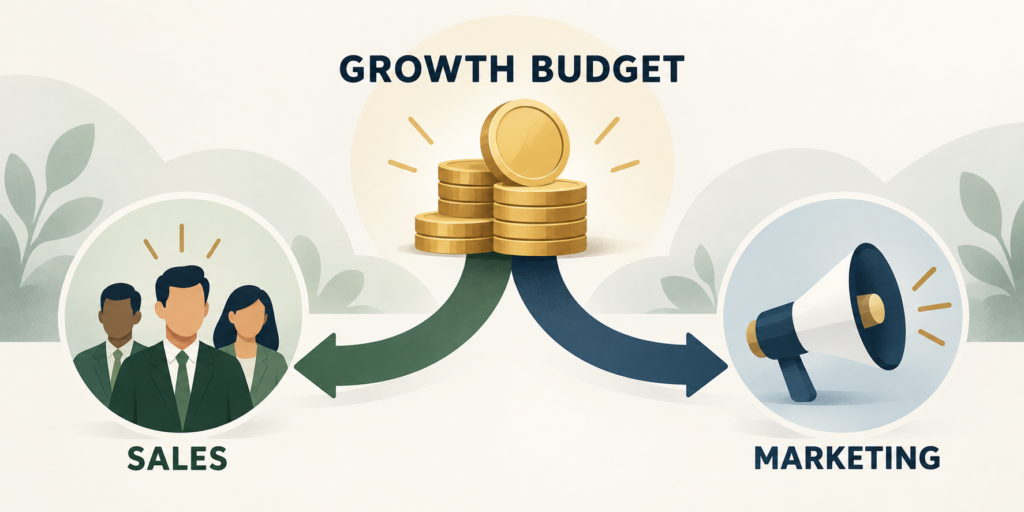
Start by listing the costs under each function. Marketing includes advertising, SEO, content, agency fees, marketing staff, website improvements, and marketing tools. Sales includes salaries, employer costs, commissions, prospecting, sales management, training, and sales tools.
Allocate shared costs once. If both teams use the CRM, divide the cost on a reasonable basis. If an employee handles selling and other duties, include only the relevant share of their cost. Track the owner’s selling time as a capacity requirement too, even if it doesn’t create an additional cash expense. Keep that estimated time cost separate from the cash budget.
Consider a hypothetical business earning $1 million annually. Its sales plan costs $80,000 and its marketing plan costs $60,000. The combined growth budget is $140,000, or 14% of revenue. That’s 8% of revenue for sales and 6% for marketing. Within the growth budget, the split is roughly 57% sales and 43% marketing.
Those percentages describe this example. They aren’t a recommended split. A business that sells directly online may need a very different allocation from one that needs meetings, estimates, and several rounds of follow-up to close a customer.
Count what you’re already spending
Before adding anything, put your existing costs in one place. Include advertising, agency fees, internal marketing costs, SEO, content, website work, CRM and tracking software, and the sales costs you’ve agreed belong in the plan.
So if your annual budget is $100,000 and you’ve already committed $70,000, you have $30,000 available to allocate. You don’t have another $100,000 waiting for campaigns.
Count each expense once. If your agency fee includes SEO and content, those services are already part of that fee. If an employee splits time between growth and other responsibilities, include the relevant share of their cost.
Work backward from a lead target
If you know how many leads you need and what they usually cost, the first calculation is straightforward:
Required leads × cost per lead = estimated advertising spend.
In a hypothetical example, 200 leads per month at $100 each would require $20,000 in monthly ad spend. Management, software, creative, and sales costs would be added to find the full budget.
The detail that needs confirming is what counts as a lead. A form submission, a qualified enquiry, and a booked appointment are different outcomes. Your target and your cost estimate need to refer to the same one.
I’d also model a range. At $80 per lead, 200 leads cost $16,000. At $150, they cost $30,000. That gives you a clearer picture of what happens if performance is better or worse than expected.
Connect the budget to a revenue target
A lead target is more useful when you know how it connects to sales.
Start with the revenue you expect without the new plan, allowing for customer losses and changes in existing accounts. Then work out the gap between that baseline and your goal.
For example, suppose a hypothetical business expects $1 million this year before additional growth activity. It’s considering two annual targets: $1.2 million or $1.4 million. That creates a gap of $200,000 or $400,000.
Next, assign responsibility for that gap. Some revenue might come from existing customer expansion, some from referrals or outbound sales, and some from marketing campaigns. Don’t ask every channel to deliver the full amount and add the same sales together more than once.
Suppose Google Ads is assigned half the gap. Each new customer produces $5,000 in revenue within the year, 20% of leads become customers, and leads cost $100.
For the $1.2 million goal, Google Ads would need to generate $100,000: 20 customers from 100 leads, requiring an estimated $10,000 in media spend.
For the $1.4 million goal, it would need to generate $200,000: 40 customers from 200 leads, requiring an estimated $20,000 in media spend.
Those are planning assumptions, not promises. The second scenario assumes you can buy more leads at the same cost and close them at the same rate. That needs testing. Both scenarios also need the supporting costs added, plus a funded plan for the other half of the revenue gap.
Keep the timeframe consistent. If a customer is worth $20,000 over five years, you can’t count all of that toward this year’s revenue goal. Allow time for leads to close and for the business to earn the revenue.
Give the sales team its own goals and expectations
If you have a sales team, its budget needs to come with clear responsibilities. Marketing should have an agreed target for qualified opportunities. Sales should have expectations for responding, following up, running meetings, preparing proposals, and turning those opportunities into revenue.
Agree on what makes an opportunity qualified before setting the targets. A form submission isn’t automatically someone ready to buy. Review lead quality and sales handling together so you can see where the process needs work.
Where prospecting is part of the sales role, give it a separate target. That could include outbound calls, partnerships, referrals, or expansion within existing accounts. Sales shouldn’t simply wait for marketing if generating its own pipeline is part of the job. But that expectation needs time in the schedule. A person handling a full inbound workload has different capacity from someone dedicated to outbound.
For a hypothetical target of 40 new customers, you might plan for 25 from marketing-generated opportunities and 15 from sales-generated opportunities. Sales would be responsible for closing all 40 and generating the pipeline for its own 15. The total remains 40 customers. Marketing sourcing an opportunity and sales closing it are two contributions to the same sale.
Work backward using the close rate for each source. At a hypothetical 20% opportunity-to-customer rate for both, that means 125 marketing-generated opportunities and 75 sales-generated opportunities. Use different rates when the actual results differ. Then check whether the team has enough time to work all 200.
Measure sales-generated pipeline, response and follow-up performance, conversion rates, and closed revenue. Activity targets should support those outcomes. A busy call log isn’t the same as a healthy pipeline.
What if you don’t have a sales team?
Many local businesses rely on inbound enquiries. There is no outbound salesperson. The owner answers estimates, a receptionist books appointments, or an office manager follows up with people who called.
That model still needs a budget for attracting enquiries and enough capacity to turn them into booked work. It doesn’t need an invented outbound target or a salesperson hired just to fit the spreadsheet.
Marketing owns the agreed target for qualified inbound enquiries. The person handling them owns answering calls, responding to forms, following up, booking appointments or estimates, and recording the outcome. Define a response standard and a process for missed calls and after-hours enquiries.
Include the relevant share of that person’s paid time, plus any booking, CRM, or follow-up tools. Don’t put an entire receptionist’s salary into growth if only part of the role involves handling new business. Show owner time separately where it isn’t an additional cash expense.
For example, suppose a hypothetical local business needs 20 new booked jobs each month and 25% of qualified enquiries become booked jobs. It needs 80 qualified enquiries. If existing referrals and organic visibility reliably provide 30, the plan needs another 50 from additional activity. Cost the marketing required to generate them and the work required to handle all 80. These are illustrative assumptions, not a forecast.
If calls are being missed or quotes aren’t followed up, some of the next investment may belong in enquiry handling. If follow-up works and there aren’t enough enquiries, review the demand-generation budget. Either way, confirm the business can deliver the additional work.
Allocate the marketing portion across SEO, ads, and supporting work
Once you have a total budget and a goal, give each part of the plan a job.
Paid search can be evaluated for capturing relevant search demand. SEO and content can be evaluated for improving organic visibility over time. Website work can address problems turning visits into enquiries. Email, CRM processes, and sales follow-up can help move enquiries and existing relationships toward a sale.
The allocation should follow the work required. A business with an established website and weak follow-up has different needs from one launching in a new market with very little visibility.
Using the earlier hypothetical $140,000 growth plan, $80,000 is assigned to sales and $60,000 to marketing. The marketing portion could be broken down like this:
| Marketing expense | Annual budget |
|---|---|
| Paid media | $24,000 |
| Agency management and strategy | $10,000 |
| SEO and content | $12,000 |
| Website and conversion improvements | $6,000 |
| Marketing software and tracking | $4,000 |
| Marketing testing reserve | $4,000 |
| Total marketing | $60,000 |
This is an illustrative allocation, not a recommended split. It assumes services don’t overlap and any marketing labour is included in the relevant line. The $80,000 sales allocation separately covers the sales resources required by this hypothetical plan.
For SEO, I’d ask for the scope behind the number: which technical issues need fixing, which pages need improving or creating, who is implementing the work, and what progress will be measured. For advertising, I’d want the estimated cost and volume of qualified opportunities. For sales, I’d want clear responsibility for contacting and following up with them.
If the total doesn’t fit, reduce the scope or change the target. Splitting a small budget across every possible channel doesn’t make the plan complete.
Check profitability and capacity before increasing the budget
Revenue alone doesn’t tell you what you can afford to spend acquiring it. You need to account for the cost of delivering the work, acquisition costs, and the profit you want to retain.
Suppose you can afford a total acquisition cost of $600 per new customer and close 20% of leads. That gives you $120 per lead for all acquisition costs. If management and sales consume $40 per lead, you have $80 left for media.
You also need enough demand and delivery capacity to support the plan. Google’s Keyword Planner can help estimate search activity and potential campaign results. Performance Planner can model budget changes for eligible existing campaigns. Use those forecasts alongside actual sales results rather than assuming a larger budget will produce proportionally more customers. [2][3]
Choose a budget you can fund and explain
I’d start by comparing a percentage-of-revenue budget with the cost of reaching your lead and revenue targets. If those numbers are far apart, work through the assumptions before committing.
Then separate sales and marketing costs, assign responsibilities, and agree on how you’ll measure progress. If you have a sales team, include its own pipeline expectations where prospecting is part of the role. If you rely on inbound enquiries, include the people and time needed to handle them. Review qualified opportunities, customers, revenue, and combined acquisition costs together.
You should be able to explain where the money is going, what you expect it to accomplish, and what would make you change the allocation. That’s a much more useful answer than picking a percentage and hoping it works.
Sources
[1] BDC — What is an average marketing budget for a small business?
[2] Google Ads Help — About Keyword Planner forecasts
[3] Google Ads Help — About Performance Planner
[4] APQC — Combined sales and marketing budget as a percentage of revenue